Power Tools & Contractors Appliances: Wattage Requirements

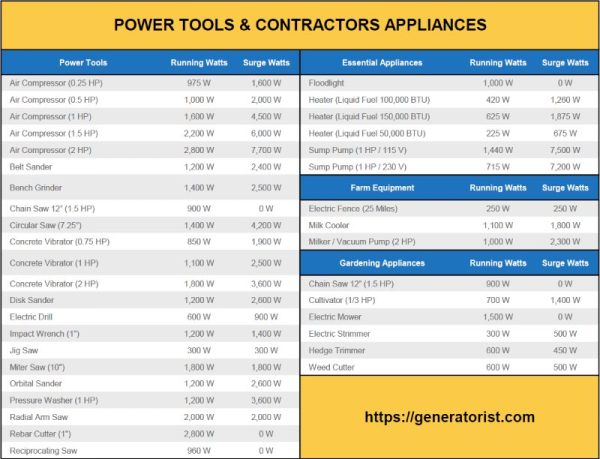
Are you a contractor looking for a new generator? Then you need to know how much power you will need to fulfill your job. That is why we have created this list of rough estimates of the wattage consumption of the most frequently used power tools.
Our team here at Generatorist has helped over 600,000 visitors find information about generators and we will help you as well. Just keep in mind that these are estimates and you need to check your tools to learn the actual numbers of running as well as starting watts.
Our data is gathered from reputable government websites, popular generator manufacturers like Honda, Generac or Yamaha and merchants like Lowe’s, Sears or Home Depot. We add new appliances and update the numbers regularly to make this the most comprehensive resource out there.

power tools & machines
Estimated wattage
| Power tools | Rated (Running) Watts | Additional Surge Watts |
|---|---|---|
| Air Compressor (0.25 HP) | 975 W | 1,600 W |
| Air Compressor (0.50 HP) | 1,000 W | 2,000 W |
| Air Compressor (1.00 HP) | 1,600 W | 4,500 W |
| Air Compressor (1.50 HP) | 2,200 W | 6,000 W |
| Air Compressor (2.00 HP) | 2,800 W | 7,700 W |
| Airless Sprayer (0.33 HP) | 600 W | 1,200 W |
| Belt Sander | 1,200 W | 2,400 W |
| Bench Grinder | 1,400 W | 2,500 W |
| Chain Saw 12” (1.5 HP) | 900 W | 0 W |
| Charger (Cordless Drill) | 70 W | 80 W |
| Circular Saw (7.25″) | 1,400 W | 4,200 W |
| Concrete Vibrator (0.75 HP) | 850 W | 1,900 W |
| Concrete Vibrator (1.00 HP) | 1,100 W | 2,500 W |
| Concrete Vibrator (2.00 HP) | 1,800 W | 3,600 W |
| Disk Sander (9″) | 1,200 W | 2,600 W |
| Drain Cleaner | 250 W | 0 W |
| Electric Drill | 600 W | 900 W |
| Hammer Drill | 1,000 W | 3,000 W |
| High-Pressure Washer (1.00 HP) | 1,200 W | 3,600 W |
| Impact Wrench (1″) | 1,200 W | 1,400 W |
| Jig Saw | 300 W | 300 W |
| Jointer/Planer | 1,800 W | 1,800 W |
| Miter Saw (10″) | 1,800 W | 1,800 W |
| Orbital Sander | 1,200 W | 2,600 W |
| Radial Arm Saw | 2,000 W | 2,000 W |
| Rebar Cutter (1″) | 2,800 W | 0 W |
| Reciprocating Saw | 960 W | 960 W |
| Table Saw (10″) | 1,800 W | 2,700 W |
| Welder (Electric) | 7,800 W | 0 W |
Essential Equipment
Estimated wattage
| Power tools | Rated (Running) Watts | Additional Surge Watts |
|---|---|---|
| Floodlight | 1,000 W | 0 W |
| Heater (Liquid Fuel 100,000 BTU) | 420 W | 1,260 W |
| Heater (Liquid Fuel 150,000 BTU) | 625 W | 1,875 W |
| Heater (Liquid Fuel 50,000 BTU) | 225 W | 675 W |
| Quartz Halogen Work Light (1000 W) | 1,000 W | 0 W |
| Quartz Halogen Work Light (300 W) | 300 W | 0 W |
| Quartz Halogen Work Light (500 W) | 500 W | 0 W |
| Sump Pump (1 HP / 115 V) | 1,440 W | 7,500 W |
| Sump Pump (1 HP / 230 V) | 715 W | 7,200 W |
Farm Equipment
Estimated wattage
| Power tools | Rated (Running) Watts | Additional Surge Watts |
|---|---|---|
| Electric Fence (25 Miles) | 250 W | 250 W |
| Milk Cooler | 1,100 W | 1,800 W |
| Milker / Vacuum Pump (2.00 HP) | 1,000 W | 2,300 W |
Gardening Power Tools
Estimated wattage
| Power Tools | Rated (Running) Watts | Additional Surge Watts |
|---|---|---|
| Chain Saw 12” (1.5 HP) | 900 W | 0 W |
| Cultivator (1/3 HP) | 700 W | 1,400 W |
| Electric Leaf Blower (Handheld) | 2,500 W | 0 W |
| Electric Mower | 1,500 W | 0 W |
| Electric Strimmer | 300 W | 500 W |
| Hedge Trimmer | 600 W | 450 W |
| Weed Cutter | 600 W | 500 W |
Printable Chart
Determining your
wattage requirements
If you want to learn what electronic appliances will your generator run, you need to get ready to do some math. Don’t worry, it will be a very simple process of adding up several numbers.
To determine what appliances you can run on this type of generator at the same time, you need to follow these steps:
- List all electronic appliances in your home you want to keep running in the case you are out of power (here is a great list full of appliances you might use)
- Write information from their name tags on required running and starting watts into a table (see examples below)
- Then you need to add up all the running watts required to operate your appliances
- The next step is to find the item with the highest additional starting watts
- Then add this number to your total running watts
- The final number represents the amount of starting watts your generator needs to provide
Here is a good example of calculating wattage needs for a 4000 watt generator.
We have decided that in case of a weather-caused blackout, we would need only essentials such as refrigerator with a freezer so our food will be safe, a lamp that will serve as an emergency light source, a small window AC unit to keep the temperature under control, a toaster, and a laptop.
| Selected Appliances | Rated (Running) Watts | Additional Starting Watts |
|---|---|---|
| Toaster | 850 W | 0 W |
| Refrigerator / Freezer | 700 W | 2,200 W |
| Laptop | 50 W | 0 W |
| Lamp (2 Lightbulbs) | 150 W | 0 W |
| Window AC (10,000 BTU) | 1,200 W | 3,600 W |
| TOTAL | 2,950 W | |
| 6,550 W |
As you can see in our example above, if we add up all running watts of our appliances we get the number 2,950 – so we are well within the 4,000 running watts limit (850 + 700 + 50 + 150 + 1,200 = 2,950).
However, we would need a generator that is capable of producing at least 6,550 surge (starting) watts to power all these appliances (2,950 + 3,600 = 6,550).
Just keep in mind that some electric appliances in your home may not have running watts provided on their data tags. If this is the case, you can estimate the running watts required thanks to the following formula:
Watts (W or kW) = Volts (V) x Amps (A)
Amps (A) = Watts (W or kW) / Volts (V)
So, as long as you have required Volts and Amps, you can easily convert them into an estimate of required running watts. Maybe you remember that this equation represents the Ohm’s law from High School physics.
Luckily, there is a device called “appliance load tester” that you can get to determine how many watts each your appliance takes. You can easily get one from Amazon and avoid all that physic´s equation.
You need to check each appliance / power tool in your home individually to see the precise wattage requirements. Feel free to check out the wattage requirements of the most popular household appliances, RV & camping appliances, or power tools for contractors here on Generatorist.