Power Consumption of Household Appliances

Are you in search of a backup generator for your home? Before you buy one, it’s important to understand the power requirements of the electrical appliances and tools you need to keep running during a power outage.
I have great news for you! Our team here at Generatorist has helped over 600,000 people find the information they need about generators and we’re here to help you too.
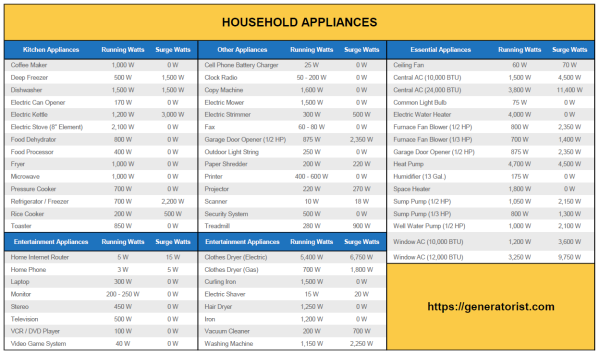
These tables & charts will help you determine the size and power of the generator you’ll need as a backup source of power. Be sure to check the actual wattage consumption of each appliance and power tool in your home separately.
Our information is sourced from reputable government websites and popular generator manufacturers such as Honda, Generac, and Yamaha, as well as merchants like Lowe’s, Sears, and Home Depot. We add new appliances and update the numbers on a regular basis to make this the most comprehensive resource out there.

Essential Appliances
Estimated wattage
| Household Appliances | Rated (Running) Watts | Additional Surge Watts |
|---|---|---|
| Ceiling Fan | 60 W | 70 W |
| Central AC (10,000 BTU) | 1,500 W | 4,500 W |
| Central AC (24,000 BTU) | 3,800 W | 11,400 W |
| Central AC (40,000 BTU) | 6,000 W | 6,700 W |
| Dehumidifier | 240 W | 0 W |
| Electric Heater (Fan) | 2,000 W | 1,000 W |
| Electric Thermal Radiator | 500 W | 0 W |
| Electric Water Heater | 4,000 W | 0 W |
| Electric Water Heater (Immersion) | 3,000 W | 0 W |
| Electric Water Heater (Tankless) | 6,600 W | 2,200 W |
| Evaporative AC | 2,600 W | 0 W |
| Furnace Fan Blower (1/2 HP) | 800 W | 2,350 W |
| Furnace Fan Blower (1/3 HP) | 700 W | 1,400 W |
| Garage Door Opener (1/2 HP) | 875 W | 2,350 W |
| Heat Pump | 4,700 W | 4,500 W |
| Humidifier (13 Gal.) | 175 W | 0 W |
| Light Bulb (Common) | 75 W | 0 W |
| Light Bulb (LED) | 9 W | 0 W |
| Night Light | 1 W | 0 W |
| Oversink Water Heater (Hand Wash) | 3,000 W | 0 W |
| Space Heater | 1,800 W | 0 W |
| Sump Pump (1/2 HP) | 1,050 W | 2,150 W |
| Sump Pump (1/3 HP) | 800 W | 1,300 W |
| Tube Light (1500mm) | 22 W | 0 W |
| Well Water Pump (1/2 HP) | 1,000 W | 2,100 W |
| Window AC (10,000 BTU) | 1,200 W | 3,600 W |
| Window AC (12,000 BTU) | 3,250 W | 9,750 W |
Kitchen Appliances
Estimated wattage
| Household Appliances | Rated (Running) Watts | Additional Surge Watts |
|---|---|---|
| Air Fryer | 1,500 W | 0 W |
| Coffee Maker | 1,000 W | 0 W |
| Cooker Hood | 20 W | 10 W |
| Deep Freezer | 500 W | 1,500 W |
| Dishwasher | 1,500 W | 1,500 W |
| Electric Can Opener | 170 W | 0 W |
| Electric Kettle | 1,200 W | 3,000 W |
| Electric Oven | 2,150 W | 0 W |
| Electric Stove (8″ Element) | 2,100 W | 0 W |
| Espresso Coffee Machine | 1,300 W | 200 W |
| Food Dehydrator | 800 W | 0 W |
| Food Processor/Blender | 400 W | 0 W |
| Fryer | 1,000 W | 0 W |
| Hot Water Dispenser | 1,200 W | 100 W |
| Induction Hob (Per Hob) | 1,400 W | 400 W |
| Microwave | 1,000 W | 0 W |
| Modern Fridge (2001-2020) | 400 W | 600 W |
| Percolator | 800 W | 300 W |
| Pressure Cooker | 700 W | 0 W |
| Refrigerator / Freezer | 700 W | 2,200 W |
| Rice Cooker | 200 W | 500 W |
| Sandwich Maker | 700 W | 300 W |
| Side-by-Side Fridge | 800 W | 1,200 W |
| Slow Cooker | 160 W | 20 W |
| Smart Fridge | 500 W | 750 W |
| Steriliser | 650 W | 0 W |
| Toaster | 850 W | 0 W |
| Water Dispenser | 100 W | 0 W |
| Water Filter & Cooler | 70 W | 30 W |
| Wine Cooler (18 Bottles) | 83 W | 0 W |
Laundry Appliances
Estimated wattage
| Household Appliances | Rated (Running) Watts | Additional Surge Watts |
|---|---|---|
| Bathroom Towel Heater | 60 W | 90 W |
| Clothes Dryer (Electric) | 5,400 W | 6,750 W |
| Clothes Dryer (Gas) | 700 W | 1,800 W |
| Curling Iron | 1,500 W | 0 W |
| Electric Shaver | 15 W | 20 W |
| Electric Shaver | 15 W | 5 W |
| Extractor Fan | 12 W | 0 W |
| Hair Dryer | 1,250 W | 0 W |
| Heated Bathroom Mirror | 50 W | 50 W |
| Iron | 1,200 W | 0 W |
| Power Shower | 7,500 W | 10,500 W |
| Steam Iron | 2,200 W | 300 W |
| Straightening Iron | 75 W | 300 W |
| Vacuum Cleaner | 200 W | 200 W |
| Washing Machine | 1,150 W | 2,250 W |
Entertainment Appliances
Estimated wattage
| Household Appliances | Rated (Running) Watts | Additional Surge Watts |
|---|---|---|
| Amazon Echo | 3 W | 0 W |
| Amazon Echo Show | 2 W | 2 W |
| Apple TV | 3 W | 3 W |
| AV Receiver | 450 W | 0 W |
| Computer Monitor | 25 W | 5 W |
| Desktop Computer | 100 W | 350 W |
| Guitar Amplifier | 20 W | 10 W |
| Home Internet Router | 5 W | 15 W |
| Home Phone | 3 W | 5 W |
| Home Sound System | 95 W | 0 W |
| Laptop | 50 W | 0 W |
| Mi Box | 5 W | 2 W |
| Monitor | 200 – 250 W | 0 W |
| Nintendo Switch AC Adapter | 7 W | 33 W |
| Playstation 4 | 85 W | 5 W |
| Set Top Box | 27 W | 3 W |
| Stereo | 450 W | 0 W |
| Television (22″ LED) | 17 W | 0 W |
| Television (49″ LED) | 85 W | 0 W |
| Television (82″ LED) | 230 W | 65 W |
| Television (CRT) | 500 W | 0 W |
| VCR / DVD Player | 100 W | 0 W |
| Video Game System | 40 W | 0 W |
| Xbox One | 50 W | 60 W |
Other Appliances
Estimated wattage
| Household Appliances | Rated (Running) Watts | Additional Surge Watts |
|---|---|---|
| 2-Way Radio (12A) | 360 W | 0 W |
| 2-Way Radio (23A) | 840 W | 0 W |
| 2-Way Radio (35A) | 960 W | 0 W |
| Air Purifier | 25 W | 5 W |
| Cell Phone Battery Charger | 25 W | 0 W |
| Clock Radio | 50 – 200 W | 0 W |
| Copy Machine | 1,600 W | 0 W |
| DAB Mains Radio | 5 W | 4 W |
| Electric Blanket | 200 W | 0 W |
| Electric Doorbell Transformer | 2 W | 0 W |
| Electric Mower | 1,500 W | 0 W |
| Electric Trimmer | 300 W | 500 W |
| EV Home Charger | 1,600 W | 1,800 W |
| Fan (Pedestal) | 50 W | 10 W |
| Fan (Table) | 10 W | 15 W |
| Fan (Wall) | 45 W | 15 W |
| Fax | 60 – 80 W | 0 W |
| Garage Door Opener (1/2 HP) | 875 W | 2,350 W |
| Outdoor Light String | 250 W | 0 W |
| Paper Shredder | 200 W | 220 W |
| Printer (Inkjet) | 20 W | 10 W |
| Printer (Laser) | 600 W | 200 W |
| Projector | 220 W | 270 W |
| Scanner | 10 W | 18 W |
| Security System | 500 W | 0 W |
| Sewing Machine | 70 W | 10 W |
| Tablet Charger | 10 W | 5 W |
| Treadmill | 280 W | 900 W |
| Water Feature | 35 W | 0 W |
Printable Chart
Determining your
wattage requirements
If you want to learn what electronic appliances will your generator run, you need to get ready to do some math. Don’t worry, it will be a very simple process of adding up several numbers.
To determine what appliances you can run on a 4000 watt generator at the same time, you need to follow these steps:
- List all electronic appliances in your home you want to keep running in the case you are out of power (here is a great list full of appliances you might use)
- Write information from their name tags on required running and starting watts into a table (see examples below)
- Then you need to add up all the running watts required to operate your appliances
- The next step is to find the item with the highest additional starting watts
- Then add this number to your total running watts
- The final number represents the amount of starting watts your generator needs to provide
Here is an example of how to calculate the wattage requirements for a generator:
We have decided that in case of a weather-caused blackout, we would need only essentials such as refrigerator with a freezer so our food will be safe, a lamp that will serve as an emergency light source, a small window AC unit to keep the temperature under control, a toaster, and a laptop.
| Selected Appliances | Rated (Running) Watts | Additional Starting Watts |
|---|---|---|
| Toaster | 850 W | 0 W |
| Refrigerator / Freezer | 700 W | 2,200 W |
| Laptop | 50 W | 0 W |
| Lamp (2 Lightbulbs) | 150 W | 0 W |
| Window AC (10,000 BTU) | 1,200 W | 3,600 W |
| TOTAL | 2,950 W | |
| 6,550 W |
As you can see in our example above, if we add up all running watts of our appliances we get the number 2,950 – so we are well within the 4,000 running watts limit (850 + 700 + 50 + 150 + 1,200 = 2,950).
However, we would need a generator that is capable of producing at least 6,550 surge (starting) watts to power all these appliances (2,950 + 3,600 = 6,550).
Just keep in mind that some electric appliances in your home may not have running watts provided on their data tags. If this is the case, you can estimate the running watts required thanks to the following formula:
Watts (W or kW) = Volts (V) x Amps (A)
Amps (A) = Watts (W or kW) / Volts (V)
So, as long as you have required Volts and Amps, you can easily convert them into an estimate of required running watts. Maybe you remember that this equation represents the Ohm’s law from High School physics.
Luckily, there is a device called “appliance load tester” that you can get to determine how many watts each your appliance takes. You can easily get one from Amazon and avoid all that physic´s equation.
You need to check each appliance / power tool in your home individually to see the precise wattage requirements. Feel free to check out the wattage requirements of the most popular household appliances, RV & camping appliances, or power tools for contractors here on Generatorist.